Grid 101: Transmission 3#
** What is a substation on the electric grid?**
The substation consists of transformers, switches, and busses. Aside from the transformer which manipulates voltage, a distribution bus allows the power from a high-voltage line to be split for distribution into many directions. Additionally, switches and breakers allow for lines to become disconnected if needed. Lastly, it is important to note that these substations are not monitored on-site by human interaction. Instead, supervisory control and data acquisition systems (SCADA) are in place to monitor the grid remotely. Our sensor series will discuss SCADA in more detail.
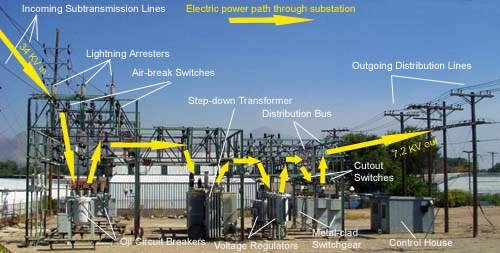
In conclusion, substations are an essential part of the grid. When electricity is generated, it must be transported very long distances across the grid. This is most efficient through high voltage, low current transmission. Since the relationship between voltage and current is inversely related, as voltage increases current decreases and vice versa. The step-up transformer is required to cause this change from low voltage to high voltage, and the step-down transformer does the opposite, returning the electricity back to low voltage and higher current. First we generate the electricity, then we transmit it over long distances, and finally we distribute it locally.